
Product Lines Are Strategy Made Visible
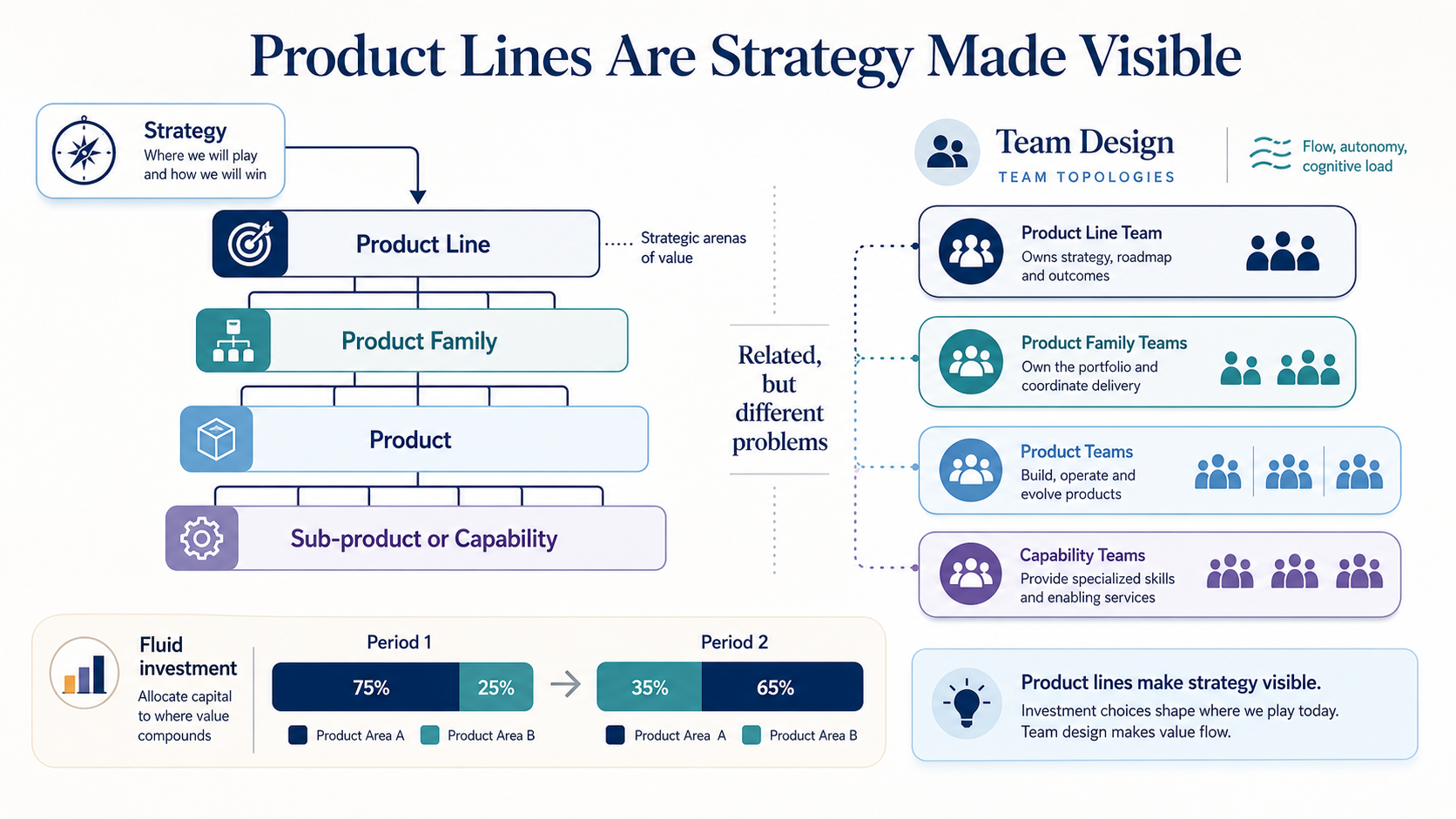
Product lines are not just a collection of systems or teams — they are a clear expression of business and product strategy, defining strategic arenas of value that guide investment decisions before they become team design decisions.
19 June 2026 · 9 min read
Many organisations want to become more product-led, but struggle with a deceptively simple question:
What are our products, and how should we organise around them?
This is where many transformations become tangled.
Teams are renamed. Value streams are mapped. Platforms are grouped. Operating models are redesigned. But underneath those changes, a more fundamental question is often left unresolved:
Where does the organisation believe value exists, who does it intend to serve, and what propositions does it want to take to market?
That is the work of product line design.
A product line is not just a collection of systems, teams, or capabilities. Done well, it is a clear expression of business and product strategy. It describes where the organisation chooses to create value, which customers it wants to serve, what problems it believes are worth solving, and what outcomes it expects those propositions to create.
In this sense, product lines make strategy visible.
They create the foundation for better investment choices, more purposeful product discovery, and more deliberate team design.
Product lines define strategic arenas of value
A good product line helps an organisation describe its market-facing intent.
It should answer questions such as:
- Which customers or users are we serving?
- What problems are we choosing to solve?
- What value proposition are we taking to market?
- What products, services, or propositions belong together?
- Where do we expect growth, retention, efficiency, differentiation, or strategic advantage to come from?
This matters because product discovery needs strategic context.
Discovery is not simply about asking customers what they want, nor is it about validating a predetermined solution. It is the work of exploring whether there is a viable intersection between: what customers value, what the business wants to offer, and what the organisation can sustainably deliver.
That is the path towards product-market fit.
Product lines help make this frame explicit. They give teams a strategic arena to explore, rather than asking them to optimise disconnected features, respond to stakeholder requests, or deliver against inherited technology boundaries.
Product families create clarity without forcing rigidity
Within a product line, product families provide a useful second level of structure.
A product family groups related products, propositions, customer problems, or capabilities in a way that helps the organisation make better decisions. The goal is not to create a perfect taxonomy. The goal is to create enough clarity so that investment, discovery, and accountability can flow more naturally.
One way to think about the hierarchy is:
| Level | Purpose |
|---|---|
| Product line | A strategic arena of value aligned to a customer group, market, proposition, or business outcome |
| Product family | A related grouping within a product line, often sharing customer problems, propositions, lifecycle logic, or capability needs |
| Product | A specific product, service, proposition, or experience that creates value for customers or users |
| Sub-product or capability | A more granular product component, enabling capability, platform service, or reusable asset that supports one or more products |
This hierarchy matters because it helps organisations find the right level of strategic conversation.
Too broad, and everything becomes abstract. Teams struggle to understand which customers, problems, or outcomes they are accountable for.
Too narrow, and the organisation fragments into small slices that create duplication, dependency, and excessive coordination.
The art is finding a level that gives teams enough strategic context to make meaningful decisions, while still allowing the organisation to shift investment as conditions change.
A strong product family should have:
- A clear customer, user, or stakeholder group
- A coherent value proposition
- A meaningful set of problems to solve
- A connection to measurable business outcomes
- Enough strategic importance to warrant ongoing attention
- Enough coherence that teams can make decisions without constant escalation
This is what helps create the conditions for empowered teams.
Empowerment does not come from simply telling teams they are empowered. It comes from giving them a clear problem space, strategic context, decision rights, and meaningful feedback loops.
Product lines and team topologies are related, but different
One of the most common mistakes organisations make is collapsing two different design problems into one: product line design and team topology design.
They are connected, but they are not the same problem.
Product line design asks: Where does the organisation intend to create value, for whom, and why?
Team topology design asks: How should teams, skills, responsibilities, and interactions be arranged to optimise flow, autonomy, cognitive load, and speed of learning?
The first is primarily a strategy, portfolio, and investment problem. The second is primarily an organisational design and delivery flow problem.
When these two problems are confused, organisations often try to make every product line map neatly to a team. Or they redesign teams before understanding which customers, propositions, or value areas matter most. Or they mistake existing technology boundaries for product boundaries.
The result is often a product operating model that looks clear on paper but becomes difficult to navigate in practice.
Teams may be called product teams, but still operate like project delivery squads. Investment may still be allocated through annual planning cycles. Discovery may remain constrained by existing structures. Strategy and delivery may continue to operate in separate worlds.
A clearer approach is to treat product lines as the strategic foundation, and team topology as a design response to current investment choices.
Investment should move more fluidly than structure
One of the greatest benefits of clear product lines is that they allow organisations to move investment more deliberately.
Product lines should inform investment decisions, but they should not automatically become fixed team structures.
In one planning period, the organisation may choose to invest heavily in one product line because it represents a major growth opportunity, customer retention risk, regulatory need, or strategic shift. In the next period, the balance may change.
The market may shift. Customer needs may evolve. A competitor may move. A constraint may be resolved. A product may mature. A new opportunity may emerge.
This is much easier when product lines are not treated as permanent team structures.
If every product line automatically becomes a fixed team, then changing investment often requires reorganisation. Reorganisation creates disruption, uncertainty, and management overhead.
But if product lines define strategic arenas of value, and teams are designed around the current investment thesis, the organisation becomes more nimble. It can shift capacity without losing strategic coherence.
This does not mean people can be moved endlessly without cost. Context matters. Domain knowledge matters. Relationships matter. Team stability matters.
But it does mean the organisation can make more conscious choices about where capacity is directed, rather than being trapped by yesterday’s structure.
Team design is a conscious trade-off
Once investment choices are clear, team design becomes a more practical conversation.
The question becomes: given where we are choosing to invest, what team structure will help us learn and deliver most effectively?
This requires trade-offs. Team design is not about finding the perfect model. It is about balancing:
- The delivery speed required in a specific area
- The level of team empowerment and autonomy desired
- The cognitive load placed on teams
- The dependencies between products, platforms, systems, and specialist capabilities
- The amount of management and coordination overhead the organisation is willing to incur
- The need for deep specialist expertise versus broad product ownership
Sometimes a product line may justify multiple long-lived teams because the opportunity is large, complex, or strategically important. Sometimes one team may work across several product families because the current investment level does not justify a dedicated team for each.
Sometimes a product may depend on sub-products, platform capabilities, shared services, or enabling capabilities that need their own ownership model. Sometimes a platform team, enabling team, or specialist capability may be needed to support flow across multiple product areas.
The point is not to force a one-to-one mapping between product lines, product families, products, capabilities, and teams.
The point is to make team design a conscious response to strategy, investment, and flow.
Better distinctions create better conversations
When product line design and team design are separated, leadership conversations improve.
Instead of asking which team owns this system? the organisation can ask: which customer problem or strategic value area does this support?
Instead of asking how do we keep every team fully utilised? the organisation can ask: where should we concentrate capacity to create the most value?
Instead of asking do we need another reorganisation? the organisation can ask: can we shift investment without changing the entire structure?
These are better questions.
They move the organisation away from static structures and towards clearer strategic intent, more deliberate investment, and more adaptive delivery. They also create better conditions for product teams.
Teams can understand the customer, the value proposition, and the problem space they are working within. Leaders can make clearer investment calls. Product discovery can become more purposeful. Delivery can be aligned to outcomes rather than activity.
A more focused and nimble organisation
Product lines and team topologies are deeply related, but they solve different problems.
Product lines help an organisation define its strategic arenas of value: who it serves, what problems it chooses to solve, what propositions it takes to market, and where it believes value can be created.
Product families, products, and sub-products or capabilities then provide more detailed levels of structure, helping the organisation understand how value is composed, delivered, supported, and evolved.
Team topologies help the organisation decide how to arrange people, skills, platforms, and interactions to deliver against those choices.
When these problems are collapsed, organisations often create operating models that are hard to fund, difficult to navigate, and slow to adapt.
When they are separated and connected deliberately, something different becomes possible.
The organisation gains a clearer view of its strategic bets. Investment can move more fluidly. Teams can be designed around the work that matters now, without losing sight of the broader product strategy.
That is the real value of product lines.
They are not just labels in an operating model.
They are strategy made visible.
Want to talk through this?
Book a free discovery call with the Berst Consulting team.